

Do Skin Supplements Actually Work? Evidence, Safety, and What to Expect
Skin supplements can work, but only if “work” is defined precisely. A capsule or powder may support a measurable outcome such as hydration, transepidermal water loss (TEWL), elasticity, or wrinkle depth. That is different from curing a skin condition, replacing sunscreen, or reversing skin aging.
The evidence is ingredient-specific, dose-specific, and outcome-specific. A positive trial of one collagen peptide, wheat lipid complex, carotenoid, or botanical extract does not validate every product in the category. The useful question is not simply, “Do skin supplements work?” It is: Which ingredient, at what dose, for which goal, over what period, and with what quality of evidence?
Table of Contents
- The Short Answer
- What Is a Skin Supplement?
- What the Evidence Actually Shows
- Which Supplement Fits Which Skin Goal?
- How to Choose a Skin Supplement
- Single Ingredients vs Multi-Ingredient Formulas
- Oral Supplements vs Topical Skincare
- How Long Skin Supplements Take
- Safety and When to Ask a Clinician
- Where ATIKA Fits
- Frequently Asked Questions
Short Answer
Some skin supplements can produce modest, measurable benefits in healthy adults. Systematic reviews report evidence for specific oral collagen and ceramide preparations on hydration and transepidermal water loss, while collagen trials also examine elasticity and wrinkle-related outcomes. Selected carotenoids, polyphenols, and botanical extracts have evidence for narrower oxidative-stress or UV-response endpoints.2–6 Results are not universal, the average change may be subtle, and many studies are small or industry-connected. A supplement is most defensible when it matches a specific goal, provides the studied ingredient at a transparent daily dose, and is used as an adjunct to – not a substitute for – sun protection, topical care, a nutrient-dense diet, sleep, and appropriate medical care.
Commercial disclosure: ATIKA sells the supplement discussed later in this article. To separate education from promotion, the evidence review below describes ingredient categories first, names important limitations, and does not assign findings from individual-ingredient trials to ATIKA’s finished formula.
What Is a Skin Supplement?
A skin supplement is an oral product intended to provide nutrients or bioactive compounds that participate in skin biology. The label may say “beauty supplement,” “nutricosmetic,” “collagen powder,” “skin hydration supplement,” or “skin longevity supplement,” but those marketing categories do not tell you whether the formula is well designed.
Most evidence-based ingredients address one or more of four broad systems:
- Structure: the extracellular matrix, including collagen-related measures such as elasticity, firmness, and wrinkle depth.
- Barrier and hydration: the lipid-rich stratum corneum that limits water loss and helps keep irritants out.
- Antioxidant defense: endogenous and dietary systems involved in the response to ultraviolet light, pollution, and normal oxidative metabolism.
- Micronutrient sufficiency: vitamins and minerals required for normal cellular, structural, and enzymatic functions.
A skin supplement is not automatically necessary because these systems also depend on food, protein intake, essential fats, sleep, hormones, health status, sun exposure, smoking, medications, and topical care. If a symptom may reflect a deficiency or medical condition, choosing a beauty supplement before identifying the cause can delay the right intervention.
That distinction matters for skin longevity. Skin aging is not one pathway and does not have one oral “fix.” For the broader biology, see What Is Skin Longevity? and The Four Layers of Skin Nutrition.
Do Skin Supplements Actually Work? What the Evidence Shows
The scientifically honest answer is yes for some products and endpoints, but not as a category-wide promise. “Skin supplements” include hundreds of combinations. Human evidence is strongest when a study identifies the exact material, daily dose, participant population, comparator, duration, and instrumental endpoint.
A 2022 systematic review and meta-analysis of randomized trials found that oral collagen and ceramide supplementation improved hydration and reduced transepidermal water loss compared with placebo. The authors also reported positive hydration findings for oral hyaluronan and procyanidins, while evidence for several other categories was insufficient or less consistent.3 A broader 2024 review concluded that several nutritional compounds have promising skin applications but emphasized that evidence varies substantially by ingredient and outcome.2
Collagen illustrates why interpretation matters. Earlier meta-analyses reported improvements in hydration and elasticity across trials.4 A 2025 meta-analysis reached a more skeptical conclusion: pooled results appeared beneficial, but effects were not significant in subgroups of non-industry-funded or higher-quality studies.5 That does not prove that every collagen product is ineffective. It does mean confidence should be calibrated to study quality, funding, formulation, and reproducibility—not to the size of the marketing claim.
| Ingredient category | Outcomes studied | Reasonable conclusion | What it does not prove |
|---|---|---|---|
| Specific collagen peptides | Hydration, elasticity, wrinkle depth or volume, and dermal-matrix markers. | Some preparations at studied doses may produce modest changes over weeks. The literature is mixed when study quality and funding are considered.4–7 | That all collagen powders are equivalent, that more grams are always better, or that collagen alone addresses every driver of skin aging. |
| Oral ceramide or wheat polar-lipid preparations | Hydration, transepidermal water loss, smoothness, elasticity, roughness, and wrinkle measures. | Selected preparations have human evidence for barrier- and hydration-related outcomes.3, 8 | Treatment of eczema or another skin disease, equivalence among all plant sources, or guaranteed visible improvement. |
| Selected carotenoids, polyphenols, and botanical extracts | UV-induced redness, minimal erythema dose, pigmentation, hydration, elasticity, and oxidative-stress markers. | Some standardized ingredients influence specific photobiology or skin-condition endpoints.9–11 | An oral SPF, freedom to extend sun exposure, prevention of DNA damage or skin cancer, or a substitute for sunscreen. |
| Vitamins and minerals | Normal nutrient-dependent functions and correction of inadequate intake or deficiency. | Correcting a true deficiency can matter greatly. Adequate vitamin C, zinc, and other nutrients are required for normal skin biology. | That megadoses improve “glow” in an already well-nourished person, or that more is safer or more effective. |
The most reliable studies use instrumental measurements rather than an undefined promise of “glowing skin.” Hydration, TEWL, cutometry-based elasticity, wrinkle imaging, or a controlled UV-response endpoint can be measured. “Detox,” “anti-aging,” and “radiance” require more careful translation because the words may combine several biological and perceptual outcomes.
Which Supplement Fits Which Skin Goal?
There is no universal “best skin supplement.” Start with the outcome you want to influence, then look for an ingredient and dose studied for that outcome.
For hydration and barrier support
Oral ceramide or wheat polar-lipid preparations are a logical category when dryness, water loss, or barrier support is the main goal. Oral collagen and hyaluronan have also been studied for hydration, but they are not mechanistically identical.3, 8 Compare the named preparation and daily dose with the study—not just the word “ceramide” on the front label. For the full mechanism and evidence boundaries, read Oral Ceramides: The Skin Hydration Mechanism Topicals Miss.
For elasticity, firmness, and wrinkle-related measures
Specific collagen peptides are the most studied oral category for structural endpoints. Their evidence should be presented with both sides visible: multiple trials and earlier meta-analyses report benefits, while the 2025 meta-analysis found that apparent effects did not remain significant in certain higher-quality or non-industry-funded subgroups.4–7 The correct takeaway is neither “collagen is proven” nor “collagen is useless.” Product-specific evidence, dose, study quality, and expectations matter. See Does Collagen Actually Work? for the full analysis.
For oxidative-stress and photobiology support
Astaxanthin, other carotenoids, selected citrus polyphenol preparations, and Polypodium leucotomos have been studied for specific UV-response, pigmentation, hydration, or elasticity endpoints.9–11 These ingredients are adjuncts. They do not replace broad-spectrum sunscreen, protective clothing, shade, or the diagnosis and treatment of pigment disorders. Start with Antioxidant Supplements for Skin: Do They Actually Work? for the category review.
For a suspected vitamin or mineral deficiency
This is a different decision. New hair shedding, marked dryness, mouth changes, unusual pigmentation, brittle nails, fatigue, or other symptoms can have nutritional and non-nutritional causes. A clinician can use the history, examination, diet, medications, and laboratory testing when appropriate. Correcting a confirmed deficiency is more clinically meaningful than guessing with a broad beauty blend. See If You Can’t Name the Deficiency.
The Goal-Matching Rule
Do not ask whether an ingredient is “good for skin” in the abstract. Ask whether the exact preparation and daily dose have human evidence for the outcome you care about. Hydration, TEWL, elasticity, wrinkle depth, pigmentation, and UV-induced redness are different endpoints.
How to Choose a Skin Supplement: A Seven-Point Checklist
- Name the goal. “Better skin” is too vague. Choose hydration, barrier support, elasticity, wrinkle appearance, oxidative-stress support, or deficiency correction.
- Identify the exact ingredient source. “Collagen,” “ceramides,” or “antioxidant blend” may describe very different materials. A branded ingredient is not automatically better, but it can make the research and dose easier to trace.
- Find the full daily dose. Read the amount per serving and the serving size. A proprietary blend that hides individual quantities prevents an evidence-based comparison.
- Compare the label with human studies. Was the same preparation studied? Was the daily dose comparable? Did the study measure your target outcome? Was the trial long enough?
- Read past the headline. Look at sample size, placebo control, blinding, participant population, dropouts, funding, conflicts of interest, effect size, and whether the finished product or only one ingredient was tested.
- Check quality and allergens. Look for manufacturing and contaminant-testing transparency. Independent quality seals can help verify identity and purity, although they do not prove effectiveness.12 Confirm fish, shellfish, bovine, wheat, soy, or other relevant sources.
- Reject impossible claims. “Reverses aging,” “replaces Botox,” “internal sunscreen,” “detoxifies skin,” and disease-treatment promises are warning signs.
Dose transparency is especially important in multi-ingredient powders. Eighteen ingredients can look more comprehensive than three, but a longer label is not evidence of adequate dosing. The formula should explain why each ingredient is present and which claims are supported by human data. Read Dosing Is Not a Detail—It’s the Mechanism.
Single Ingredients vs Multi-Ingredient Skin Supplements
A single-ingredient product is easier to evaluate. The dose is usually obvious, the evidence is easier to match, and it may be the most economical choice for one narrow goal. If hydration is the only priority, for example, a well-characterized oral ceramide preparation may be more direct than a broad formula.
A multi-ingredient formula can make biological sense when the goal spans several systems. Collagen peptides and oral ceramides do not duplicate one another: the first is studied mainly for structural outcomes, while the second is studied mainly for barrier and hydration measures. Carotenoids and polyphenols address still other pathways. Vitamins and minerals can provide cofactors required for normal physiology.
But mechanistic complementarity is not the same as clinical proof. Combining studied ingredients does not automatically show that the finished formula works better than each ingredient alone, that all components remain effective together, or that the blend produces every outcome associated with its ingredients. Those conclusions require a trial of the finished formula.
| Question | Single ingredient | Multi-ingredient formula |
|---|---|---|
| Best use | One defined goal or deficiency. | Several complementary goals and convenience. |
| Easier to verify | Usually yes, if the source and dose are disclosed. | Only if every material and daily dose are transparent. |
| Evidence boundary | Ingredient findings may apply when preparation and dose match. | Ingredient trials support rationale, not proof of the finished formula. |
Can Skin Supplements Replace Topical Skincare?
No. Oral and topical interventions have different routes, concentrations, and jobs. Broad-spectrum sunscreen reduces the ultraviolet radiation reaching skin. Moisturizers apply humectants, emollients, and occlusives directly to the stratum corneum. Retinoids and other topical actives can target defined pathways at the site of application. Prescription treatments and procedures address concerns that a supplement should not claim to treat.
Oral nutrition is systemic. It can provide substrates or bioactive compounds that reach tissues after digestion, absorption, metabolism, and distribution. That route can complement topical care, but it cannot reproduce the labeled SPF of sunscreen or the local action of a prescription.
A strong routine therefore uses the least interchangeable parts for their proper roles: nutrition for adequacy, evidence-based oral ingredients for selected adjunctive goals, moisturizers and actives for the surface, and daily sun protection to reduce preventable exposure. See How Internal Skin Nutrition and Topicals Work Together.
How Long Do Skin Supplements Take to Work?
Most meaningful skin outcomes are measured over weeks, not days. Some barrier-related measures have changed within two to four weeks in individual trials, while collagen, carotenoid, and broader skin-condition studies often run eight to twelve weeks.6–11 Hair follows a longer and less predictable cycle, so it should not be folded into a skin timeline without separate evidence.
Ninety days is a practical evaluation window, not a biological deadline. Take the product consistently at the labeled dose, keep the rest of the routine reasonably stable, and assess the outcome you chose at the beginning. Standardized photographs and simple notes about dryness, reactivity, or product use are more useful than relying on daily mirror checks.
Stop earlier if adverse effects occur. If there is no meaningful benefit after an adequate trial, continuing indefinitely because “supplements take time” is not evidence-based. For ingredient-specific timelines, see How Long Do Internal Antioxidant Supplements Take to Affect Skin? and How Long Do Collagen Supplements Take to Work?
Safety: Who Should Be More Careful?
Dietary supplements can contain physiologically active ingredients, and “natural” does not mean risk-free. The NIH Office of Dietary Supplements advises reviewing supplement use with healthcare professionals because products can interact with medications, duplicate nutrients, affect surgery, or be inappropriate for some health conditions.12
- Pregnancy or breastfeeding: review the complete formula with the appropriate clinician. Avoid assuming a beauty blend is pregnancy-safe.
- Medications or upcoming surgery: botanicals, antioxidants, vitamins, and minerals may create interactions or perioperative concerns.
- Liver or kidney disease and other medical conditions: ingredient clearance, nutrient limits, and risk may differ.
- Allergies and dietary restrictions: check collagen species and wheat, fish, shellfish, soy, or other ingredient sources.
- Overlapping supplements: total the vitamin and mineral amounts across multivitamins, beauty products, powders, and fortified foods. More is not automatically better.
- New or persistent symptoms: seek evaluation for painful, spreading, bleeding, rapidly changing, or otherwise concerning skin findings rather than using supplements as a diagnostic trial.
Biotin deserves special caution. A true deficiency can cause skin rash, hair loss, and brittle nails, but biotin deficiency is uncommon and evidence for high-dose biotin as a general skin supplement is limited. High doses can interfere with certain laboratory tests, including tests that use biotin-based technology, so tell your healthcare team what you take before bloodwork.13
Third-party quality testing can help confirm that a product contains what the label says and does not contain harmful levels of certain contaminants. It does not establish that the product is clinically effective or appropriate for you.12
Where ATIKA Advanced Skin Nutrition Fits
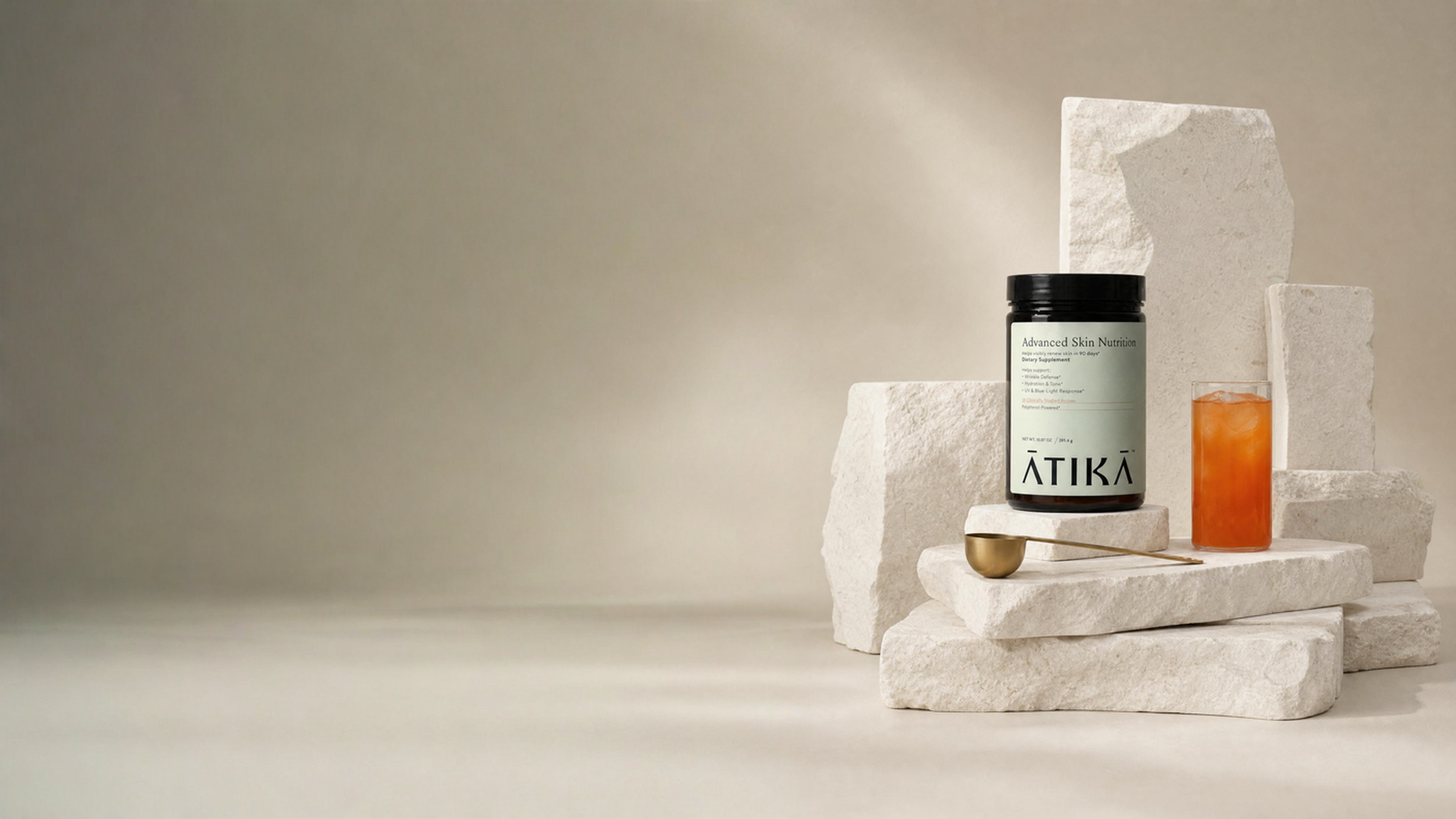
ATIKA Advanced Skin Nutrition is not simply a collagen supplement. It is an all-in-one foundational skin nutrition powder designed around four systems involved in skin aging: collagen integrity, antioxidant defense, lipid-barrier support, and cellular energy-related nutrient pathways.
The formula combines 2.5 g VERISOL® bioactive collagen peptides, 30 mg Ceramosides™ wheat polar lipids, 4 mg astaxanthin, 100 mg Red Orange Complex®, 480 mg Polypodium leucotomos, additional carotenoids and polyphenols, and vitamins, minerals, and cofactors. Several named ingredients are supplied at doses used in human studies. That supports the formulation rationale; it does not turn separate ingredient trials into a clinical trial of the completed product.
The intended role is broader than a single “beauty benefit.” Collagen peptides address structural support; oral wheat lipids address barrier and hydration measures; carotenoids, polyphenols, and botanicals represent complementary antioxidant pathways; and micronutrients support normal nutrient-dependent functions. This is the CALM Framework™: Collagen integrity, Antioxidant defense, Lipid-barrier integrity, and Mitochondrial support.
ATIKA’s Evidence Boundary
ATIKA is foundational daily skin nutrition — not sunscreen, not a drug, and not a treatment for a skin disease. Ingredient-specific human studies support the rationale for several components. The finished ATIKA formula has not yet been clinically tested to prove every outcome associated with its individual ingredients.
For full quantities and formulation rationale, review the ingredients and clinical studies, ingredient glossary, and technical white paper. For the selection philosophy, read Why Collagen Isn’t Enough: A Pharmacist’s Guide to Choosing a Skin Supplement.
Frequently Asked Questions
Do skin supplements actually work?
Some do for specific, measured outcomes. Human trials and systematic reviews support modest changes in hydration, TEWL, elasticity, or wrinkle-related measures for selected collagen and ceramide preparations, with narrower evidence for some antioxidants and botanical extracts.2–11 Results depend on the exact ingredient, dose, duration, population, adherence, and study quality.
What should I look for in a skin supplement?
Look for a formula matched to a defined goal, named ingredient sources, complete daily doses, human evidence at comparable doses, transparent allergens and quality testing, and claims that match the actual endpoints. Avoid hidden proprietary blends and products that promise to reverse aging or treat a disease.
Which supplements have the best evidence for aging skin?
No supplement has been proven best for everyone. Specific collagen peptides have the most research for selected structural measures; oral ceramide preparations have evidence for hydration and barrier measures; and selected carotenoids, polyphenols, and botanical extracts have narrower evidence for oxidative-stress or UV-response endpoints.3–11 Choose by the outcome, exact ingredient, daily dose, and study quality—not by the broad phrase “anti-aging.”
How long do skin supplements take to work?
Many studies assess outcomes after eight to twelve weeks, although some barrier measures change earlier and the timeline varies by ingredient. Ninety days is a reasonable evaluation period for many formulas, not a guarantee that every person will see visible change.
Does biotin help skin, and can it cause acne?
Biotin is essential, and a true deficiency can cause skin rash, hair loss, and brittle nails. Deficiency is uncommon, however, and evidence that high-dose biotin improves skin in people who already get enough is limited.13 People report breakouts while taking biotin, but a direct causal link with acne has not been established. Because high-dose biotin can interfere with some laboratory tests, disclose it to your healthcare team before bloodwork.
Can skin supplements replace sunscreen or topical skincare?
No. Sunscreen, moisturizers, topical actives, prescriptions, and oral supplements do different jobs. A supplement should be treated as an adjunct to a sensible routine, not a reason to skip SPF or medical treatment.
Do dermatologists recommend skin supplements?
Dermatologists generally prioritize diagnosis, sun protection, appropriate topical care, and adequate nutrition. A supplement may be discussed for a confirmed deficiency or a specific adjunctive goal, but recommendations vary by the evidence, product, person, medications, and health history. The American Academy of Dermatology recommends discussing skin, hair, and nail supplement goals with a board-certified dermatologist.1
Related Reading
- Why Collagen Isn’t Enough: A Pharmacist’s Guide to Choosing a Skin Supplement
- Does Collagen Actually Work? What Human Studies Show
- Oral Ceramides: The Skin Hydration Mechanism Topicals Miss
- Antioxidant Supplements for Skin: Do They Actually Work?
- How Internal Skin Nutrition and Topicals Work Together
- How Long Do Internal Antioxidant Supplements Take to Affect Skin?
- How Long Do Collagen Supplements Take to Work?
- What Dermatologists Recommend for Internal Skin Support
About the Author
Lily Shapiro, PharmD, is the founder and formulator of ATIKA. Her pharmacy background informs ATIKA’s evidence-first approach to ingredient selection, dosing, safety, and the limits of supplement claims.
References
- American Academy of Dermatology. Should I Take Vitamins or Supplements for My Skin? Updated June 25, 2025. Accessed August 14, 2026.
- Januszewski J, Forma A, Zembala J, et al. Nutritional supplements for skin health—A review of what should be chosen and why. Medicina. 2024;60(1):68. doi:10.3390/medicina60010068.
- Sun Q, Wu J, Qian G, Cheng H. Effectiveness of dietary supplement for skin moisturizing in healthy adults: A systematic review and meta-analysis of randomized controlled trials. Front Nutr. 2022;9:895192. doi:10.3389/fnut.2022.895192.
- Pu SY, Huang YL, Pu CM, et al. Effects of oral collagen for skin anti-aging: A systematic review and meta-analysis. Nutrients. 2023;15(9):2080. doi:10.3390/nu15092080.
- Myung SK, Park Y. Effects of collagen supplements on skin aging: A systematic review and meta-analysis of randomized controlled trials. Am J Med. 2025;138(9):1264–1277. doi:10.1016/j.amjmed.2025.04.034.
- Proksch E, Segger D, Degwert J, Schunck M, Zague V, Oesser S. Oral supplementation of specific collagen peptides has beneficial effects on human skin physiology: A double-blind, placebo-controlled study. Skin Pharmacol Physiol. 2014;27(1):47–55. doi:10.1159/000351376.
- Proksch E, Schunck M, Zague V, Segger D, Degwert J, Oesser S. Oral intake of specific bioactive collagen peptides reduces skin wrinkles and increases dermal matrix synthesis. Skin Pharmacol Physiol. 2014;27(3):113–119. doi:10.1159/000355523.
- Kern C, Dudonné S, Garcia C. Dietary supplementation with a wheat polar lipid complex improves skin conditions in women with dry skin and mild-to-moderate skin aging. J Cosmet Dermatol. 2024;23(4):1320–1330. doi:10.1111/jocd.16130.
- Ito N, Seki S, Ueda F. The protective role of astaxanthin for UV-induced skin deterioration in healthy people—A randomized, double-blind, placebo-controlled trial. Nutrients. 2018;10(7):817. doi:10.3390/nu10070817.
- Nobile V, Burioli A, Yu S, et al. Photoprotective and antiaging effects of a standardized red orange extract in Asian and Caucasian subjects: A randomized, double-blind, controlled study. Nutrients. 2022;14(11):2241. doi:10.3390/nu14112241.
- Faisal A, Philipsen PA, Lerche CM, et al. Changes in ultraviolet B radiation-induced DNA damage and erythema after oral nicotinamide and Polypodium leucotomos in healthy volunteers: An intraindividual controlled trial. Photochem Photobiol Sci. 2025;24(11):1951–1958. doi:10.1007/s43630-025-00807-7.
- National Institutes of Health Office of Dietary Supplements. Dietary Supplements: What You Need to Know. Updated January 4, 2023. Accessed August 14, 2026.
- National Institutes of Health Office of Dietary Supplements. Biotin: Fact Sheet for Health Professionals. Updated January 10, 2022. Accessed August 14, 2026.
Disclaimer
This article is educational and is not medical advice. Dietary supplements are not intended to diagnose, treat, cure, or prevent disease and do not replace broad-spectrum sunscreen, appropriate topical care, a balanced diet, or medical treatment. Consult a qualified healthcare professional before beginning a supplement, particularly if you are pregnant, nursing, taking medication, preparing for surgery, managing a medical condition, or concerned about a new or persistent skin change.

Written by Lily Shapiro, PharmD
Lily Shapiro is a Doctor of Pharmacy and the founder of ATIKA, a clinically grounded ingestible skin-health brand focused on skin longevity. She formulated Advanced Skin Nutrition as a foundational, all-in-one daily powder that combines collagen peptides, Ceramosides® phytoceramides, targeted antioxidants, carotenoids, polyphenols, vitamins, minerals, and cofactors at evidence-based oral doses. Her work centers on translating peer-reviewed research in nutritional dermatology and healthy aging into simple, transparent formulations that support long-term skin structure, barrier function, and the skin's defenses against everyday oxidative stress.

Leave a comment
This site is protected by hCaptcha and the hCaptcha Privacy Policy and Terms of Service apply.